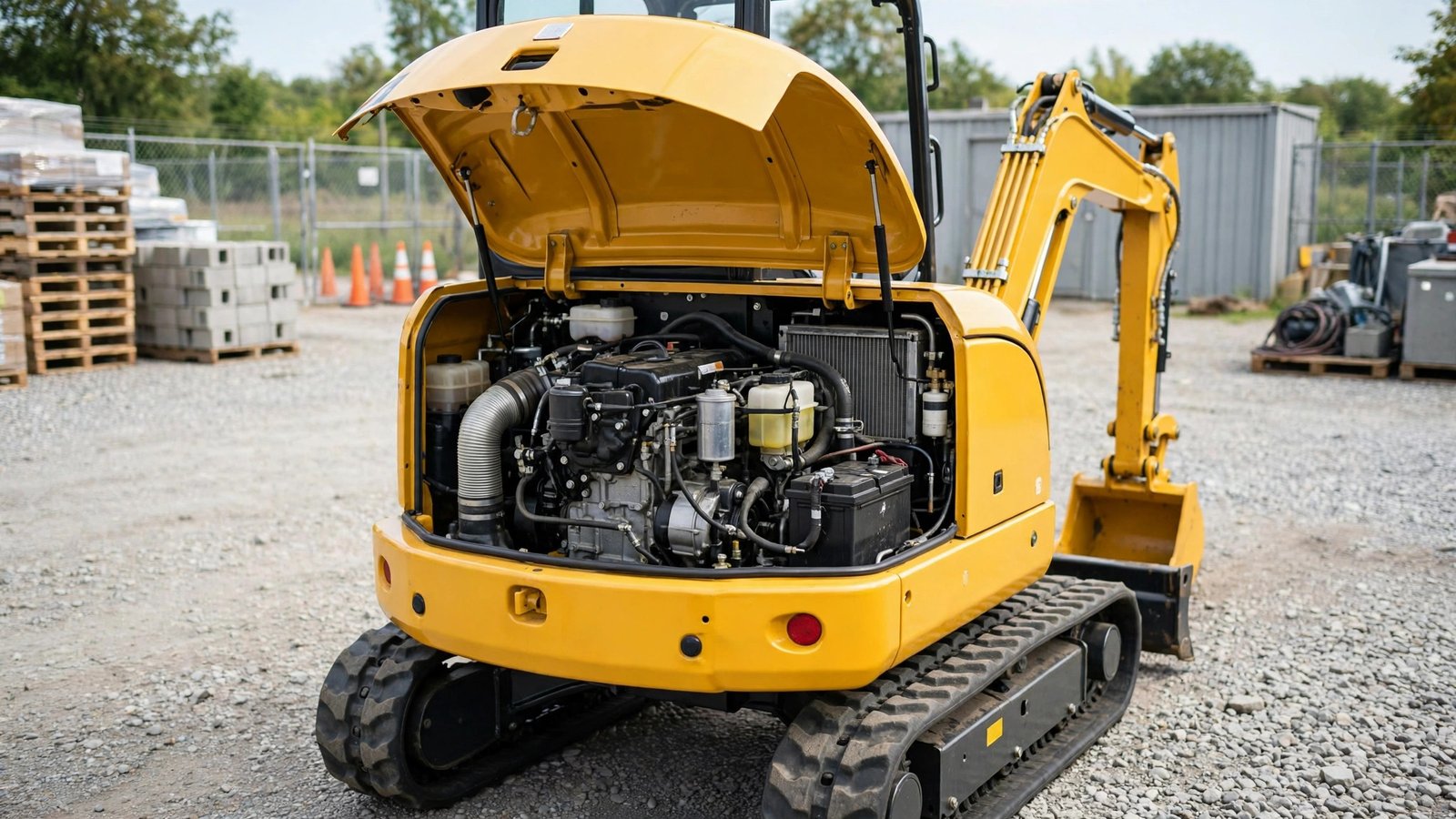
The engine is the part of a mini excavator a buyer asks about first and understands least. It is also the part that decides whether the machine starts on a cold morning, digs well in hard ground, and keeps working year after year. This guide explains what the engine does, the difference between diesel and petrol, and what each of the common engine names — Kubota, KOOP, Briggs & Stratton, and Laidong — generally means for a buyer. It does not quote power, displacement, or model numbers for any engine, because those figures depend on the exact model and configuration; confirm them on the specification sheet for the machine you plan to order.
What the engine does in a mini excavator
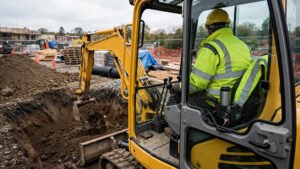
The engine does not dig. It makes power, and the hydraulic system turns that power into digging, lifting, and swinging. The engine drives a hydraulic pump, the pump pushes oil through hoses and valves, and that oil pushes the cylinders that move the boom, arm, bucket, and tracks.
That is why an engine problem rarely looks like an engine problem. A machine that digs slowly, lifts weakly, or swings with difficulty may have a healthy-sounding engine and a hydraulic fault — or a tired engine that cannot drive the pump properly. When you test a machine, listen to the engine under load, not just at idle. It should hold its speed when the bucket bites into firm ground, without hunting, smoking heavily, or stalling.
Diesel vs petrol: the basic choice
Most mini excavators run on diesel, and for good reason. A diesel engine produces strong torque at low speed, which is what digging needs. It is fuel-efficient over a long working day, and it is built to run for many hours under load. Diesel engines are also the standard for construction equipment, so fuel, filters, and service knowledge are easy to find in most markets.
Petrol engines appear on the smallest machines, usually where the machine is light, the work is short, and the buyer wants a simple engine that starts easily and costs less to buy. A petrol engine is generally lighter and quieter at idle, and it suits occasional garden and farm work. It usually uses more fuel over a long day, and it is less common on machines that work daily on a building site.
Kubota: the familiar name
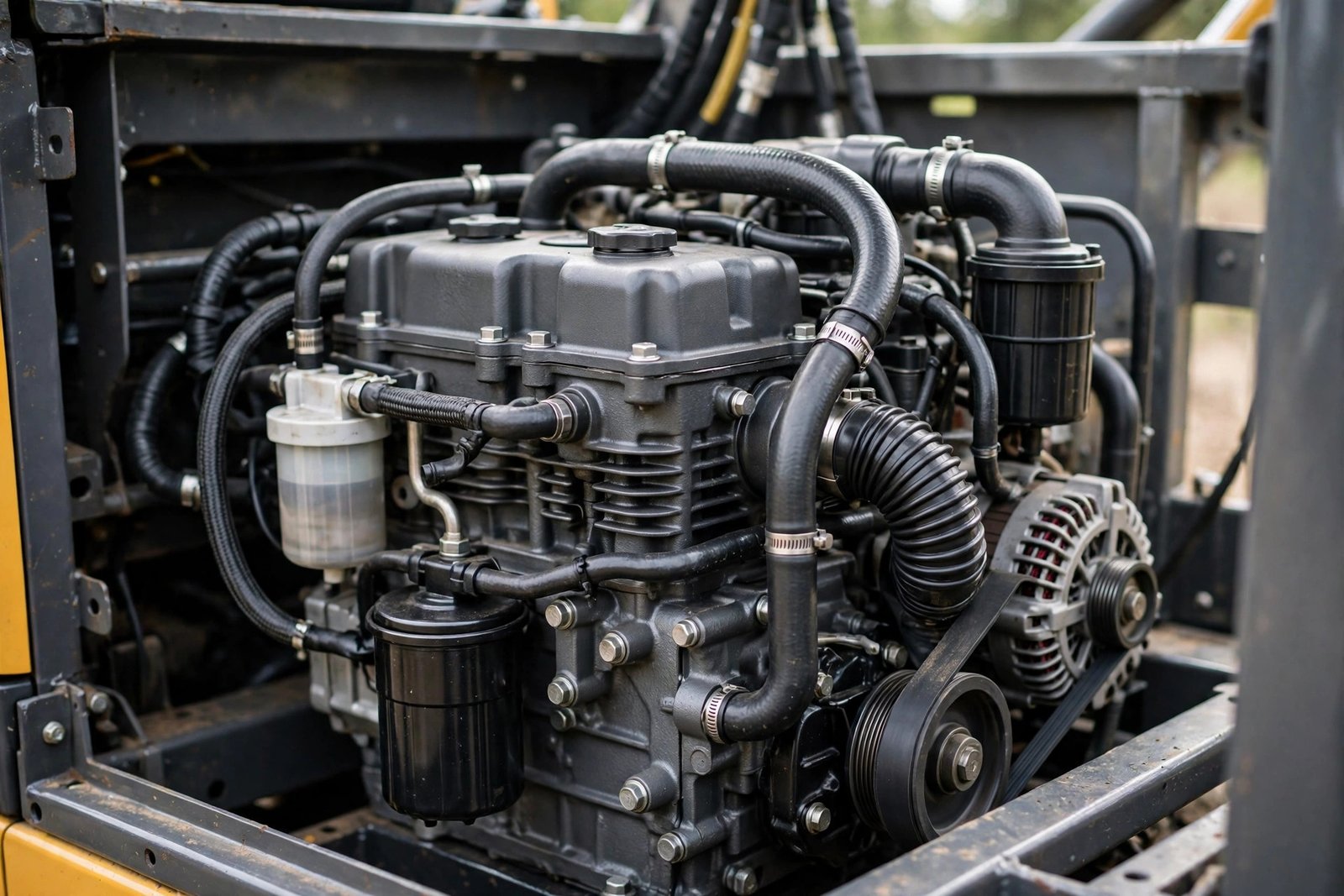
Kubota is the engine name most buyers recognise first. Kubota engines are made in Japan and are fitted to a wide range of construction, agricultural, and industrial machines around the world. That wide use is the practical advantage: parts, filters, and service knowledge are available in most markets, and many workshops have worked on a Kubota engine before.
In general terms, Kubota engines have a reputation for smooth running, easy starting, and long service life when they are maintained on schedule. They are a common choice on compact machines, where a small, quiet engine that fits a tight engine bay matters.
KOOP: the Chinese diesel workhorse
KOOP is a Chinese diesel engine brand, widely fitted to compact construction and agricultural machines made in China. It is a practical, straightforward engine, built for machines where a reliable diesel at a lower cost matters more than a premium badge.
In general terms, KOOP engines are known for simple construction, easy maintenance, and parts that are widely available through Chinese suppliers. For a buyer who orders direct from a Chinese manufacturer, that matters: filters, injectors, and service parts can be ordered with the machine.
The trade-off is familiarity in the destination market. A workshop in Australia or Europe may not have worked on a KOOP engine before, so ask your supplier what spare parts to keep on hand — filters, belts, and a fuel pump are a sensible start — and whether a service manual in English is supplied with the machine.
Briggs & Stratton: the petrol option
Briggs & Stratton is an American engine maker, best known for small petrol engines on lawnmowers, garden equipment, and small machines. On a mini excavator, a Briggs & Stratton engine usually means a petrol machine in the smallest size class.
In general terms, these engines are simple, light, and easy to start, and parts are widely available in markets where garden and small-engine equipment is common. They suit a buyer who wants a small, simple machine for light work and does not want to deal with diesel fuel, glow plugs, or a heavier engine. The limit is the same as for any small petrol engine: it is not built for long days of heavy digging.
Laidong: the other Chinese diesel
Laidong is another Chinese diesel engine brand, fitted to agricultural and compact construction machines. Like KOOP, it is a practical diesel engine, built for machines where cost, simplicity, and parts availability through Chinese suppliers matter.
In general terms, Laidong engines are known as sturdy, simple diesels, suited to farm and light construction work. As with KOOP, ask the supplier to confirm the exact engine fitted, the oil and filter types, and which spares to keep on hand.
Parts and service: the question that matters most
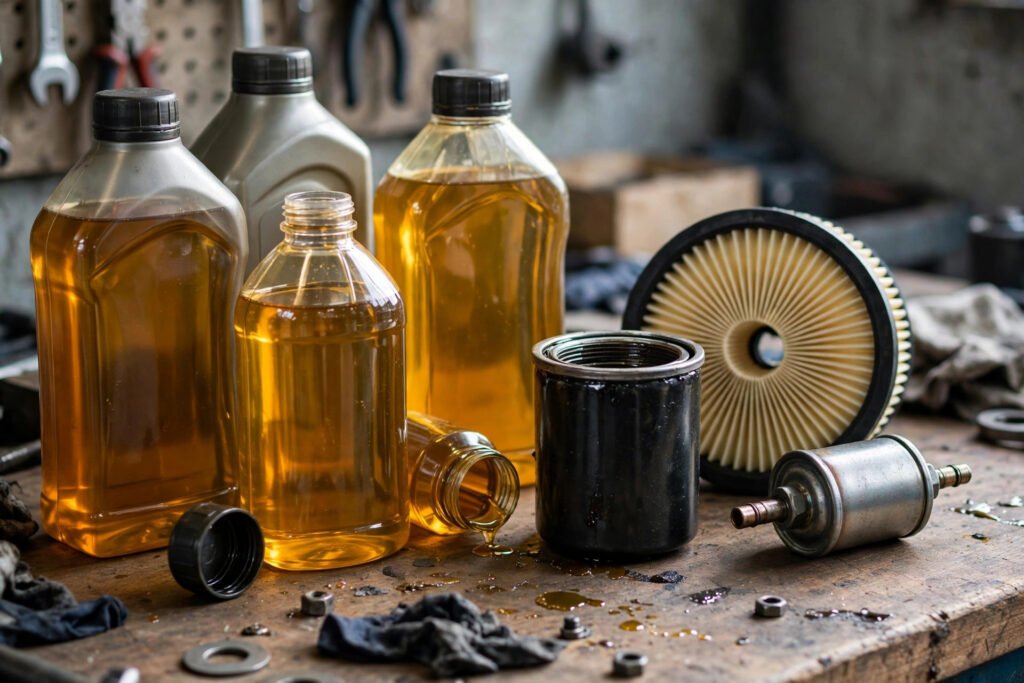
The engine name is only half the decision. The other half is parts and service where you work. Before you order, ask four questions. First, which exact engine is fitted to the model and configuration you plan to order? Second, what oil, filters, and fuel filter does it take, and are they standard parts you can buy locally? Third, what spare parts should you keep on hand? Fourth, who in your area can service that engine, and does the supplier provide a service manual in your language?
A well-known engine with no local parts supply is a worse choice than a less familiar engine with a supplier who stocks spares and answers the phone.
How to choose
Choose the engine the way you choose the machine: by the work, not by the badge. If the machine will work long days in firm ground, choose a diesel engine with good local parts support. If the work is light and occasional, a small petrol engine may be enough. If you order direct from China, confirm the exact engine, the parts list, and the service manual before you pay.
The engine is only as good as its care
An engine does not make a mini excavator good on its own. It makes the machine reliable, strong, and easy to live with — when it is the right engine for the work, when parts are available, and when it is serviced on time. Measure your work first, confirm the exact engine and its parts before you order, and keep the service routine simple and regular.
Tell Sparkle One about your work — the ground, the hours, the climate, and where you will service the machine — and we will help you confirm the right engine option for your model. Minimum order is 1 unit, and our team replies within 24 hours. Contact us on WhatsApp at +86 151 2992 2907 to discuss your requirements.