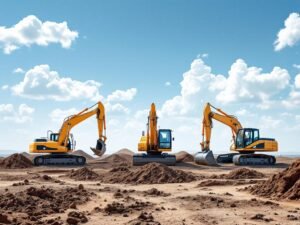
The global construction machinery market is highly competitive, and Chinese excavators have become a popular choice for contractors, rental companies, and machinery traders around the world. Thanks to their strong cost–performance ratio, wide model range, and flexible production capacity, more and more buyers are turning to China as a key sourcing hub.
However, importing excavators is not as simple as buying a consumer product online. It involves product selection, compliance, logistics, customs clearance, and after-sales support. This guide walks you through the entire process of importing excavators from China, step by step, so you can reduce risks and control your total cost.
1. Why Import Excavators from China?
1.1 Competitive Pricing
-
Lower purchase cost: Compared with similar models from Europe, Japan, or the U.S., Chinese excavators usually offer a lower purchase price for the same tonnage and basic configuration.
-
More options for different budgets: From top-tier national brands to smaller OEM factories, you can choose different price levels to match various project needs.
-
Lower spare parts cost: Wear parts, hydraulic components, and structural parts are often cheaper when sourced from China, which helps reduce long-term maintenance costs.
1.2 Strong Manufacturing and Delivery Capacity
-
Mature production lines allow shorter lead times for most standard models.
-
Many factories can offer OEM/ODM services, customizing colors, logos, and partial configurations to help you build your own brand.
1.3 Wide Range of Models
-
Mini excavators (0.8–3 tons) for landscaping, agriculture, small demolition, and narrow work sites.
-
Medium excavators (6–15 tons) for municipal projects, roadworks, and general construction.
-
Large excavators (20–50+ tons) for mining, major infrastructure, and heavy earthworks.
2. Preparation: Know Your Needs and Local Requirements
Before contacting Chinese suppliers, you need to be very clear about two things:
-
What type of excavator do you need?
-
Which country/region will you import into?
Both product specifications and import regulations depend on these two points.
2.1 Define Your Application and Technical Requirements
Create a simple requirement sheet and share it with potential suppliers. It should include:
-
Application scenario: earthmoving, demolition, landscaping, agriculture, mining, municipal projects, etc.
-
Operating weight / tonnage: e.g., 2 tons, 6 tons, 13 tons, 20 tons, 30 tons…
-
Engine brand and emission standard: e.g., engines that meet EU Stage V, EPA Tier 4 Final, or other applicable standards.
-
Hydraulic system brand: specify if you need branded pumps, valves, and motors.
-
Attachments: breakers, augers, grapples, quick couplers, etc.
-
Cab features: air conditioning, suspension seat, monitor, cameras, safety devices, etc.
-
Color and branding: company colors, custom logo, model decals (especially if you want to build your own brand).
The clearer your requirements, the more accurate the supplier’s quotation and configuration will be.
2.2 Understand Local Regulations and Certifications
Different countries have different rules for emissions, safety, noise, and compliance. Examples (always confirm with your local authorities):
-
European Union
-
Machinery needs to meet relevant directives for CE marking.
-
Engines often need to comply with EU Stage V emission standards (depending on power range).
-
-
North America (U.S. / Canada)
-
Engines typically must comply with EPA Tier 4 Final emission standards.
-
Safety rules may be influenced by local occupational safety regulations.
-
-
Other regions (Middle East, Africa, Southeast Asia, etc.)
-
Emission and certification requirements may be more flexible, but large projects may still require specific standards from project owners.
-
Before placing an order, talk to:
-
A local customs broker or freight forwarder to confirm HS code, import duties, VAT, and any special permits.
-
Local authorities or certification bodies to understand if special certification, inspection, or licenses are needed for used or new machinery.
3. How to Find and Select Reliable Suppliers in China
3.1 Where to Find Suppliers
Common channels include:
-
B2B platforms: such as global online marketplaces and Chinese manufacturing portals.
-
Industry exhibitions: construction machinery trade shows in China or internationally; you can see machines and talk face-to-face.
-
Official websites and associations: use manufacturers’ official sites or industry association member lists.
-
Recommendations: referrals from peers, part suppliers, or logistics partners.
3.2 Key Points for Initial Screening
When you shortlist suppliers, focus on:
-
Manufacturer vs. trading company
-
Ask for factory address, business license, and production line photos or videos.
-
-
Export experience
-
Have they exported excavators to your country or region before?
-
-
Main markets
-
If they already export to Europe or North America, they are more likely to understand high emission and safety standards.
-
-
Certifications and documents
-
Basic certificates like CE and ISO9001, as well as emission certificates for engines and key components.
-
-
Communication and professionalism
-
Can they answer technical questions clearly and respond in a timely manner?
-
4. Quotation and Negotiation: Understand Every Cost
4.1 Common Trade Terms
When you receive a price, it is usually under one of the standard Incoterms:
-
EXW (Ex Works): pick up from the factory; you handle all transport and export.
-
FOB (Free on Board): supplier delivers to the loading port in China and handles export customs; costs after loading are on you.
-
CFR (Cost and Freight): includes sea freight to your destination port, but not insurance or local charges.
-
CIF (Cost, Insurance, and Freight): includes machine price, sea freight, and insurance to your destination port; you handle customs clearance, duties, and inland delivery.
To compare different suppliers fairly, ask them to quote under the same trade term (e.g., all FOB or all CIF).
4.2 What a Good Quotation Should Include
When you evaluate a quotation, check:
-
Machine model and detailed configuration
-
Standard and optional attachments included (buckets, hydraulic lines, tool kits, etc.)
-
Warranty period and coverage (e.g., 12 months or a certain number of hours)
-
Whether free spare parts are included and the exact list
-
Delivery time: how many days after receiving the deposit will the machine be ready to ship?
-
Spare parts and technical support policy (email, video calls, on-site engineers, etc.)
-
Required documents: English manuals, parts catalog, quality certificate, and export documents.
5. Quality Control and Inspection: Don’t Leave Risk Until After Shipment
5.1 Sample Machine and Third-Party Inspection
For large orders or first-time cooperation, you can:
-
Purchase one sample unit and test it in your own working conditions before placing a bulk order.
-
Or hire a third-party inspection company in China to check the machines at the factory before shipment.
A typical inspection may include:
-
Welding quality and structural integrity
-
Hydraulic system performance and any visible leaks
-
Engine performance, noise, and exhaust condition
-
Full function tests (swing, boom, arm, bucket, travel)
-
Verification of attachments, tools, and documents
The inspection company will issue a detailed report with photos and comments, helping you identify potential issues early.
5.2 Factory Testing and Reports
Ask the supplier:
-
Do they have an internal testing procedure before delivery?
-
Can they provide test reports or key data (pressures, temperatures, flow rates, etc.)?
These documents can be helpful for both internal records and future discussions with your end customers.
6. Payment Methods and Key Contract Terms
6.1 Common Payment Terms
-
T/T (Telegraphic Transfer)
-
Very common: 30% deposit, 70% before shipment or against copy of Bill of Lading.
-
Suitable for medium-sized orders and long-term partnerships.
-
-
L/C (Letter of Credit)
-
Offers more security for both sides but involves higher banking costs and more complex procedures.
-
Often used for large-value contracts.
-
-
Milestone payments
-
For big projects, payments may be tied to specific milestones (production start, testing, shipment, commissioning, etc.).
-
6.2 Contract Points You Should Clarify
In the contract or Proforma Invoice (PI), clearly specify:
-
Detailed model, configuration list, color, and logo requirements
-
Trade term (FOB, CIF, etc.), loading port, and destination port
-
Delivery time and penalties or liability for delays
-
Warranty terms: start date (shipment, arrival, or final acceptance), coverage, and solutions (replacement parts, technical support, etc.)
-
Packaging and protection requirements (rust prevention, tarpaulin, wooden crate, container lashing method)
-
Required documents and language (English manuals, CE declaration, emission certificates, etc.)
-
Dispute resolution: governing law and arbitration body, if needed
7. Shipping and Customs Clearance: Getting the Excavator to Your Site
7.1 Main Shipping Options
-
Ro-Ro (Roll-on/Roll-off)
-
Suitable for large excavators. Machines are driven on and off the ship.
-
-
Container shipping (20ft/40ft)
-
Common for mini and medium excavators. The boom or other parts may be removed to save space.
-
-
Break bulk
-
For oversized or heavy machine shipments where container or Ro-Ro is not suitable.
-
You can either:
-
Let the Chinese supplier arrange shipping (common for CIF).
-
Use your own freight forwarder familiar with construction equipment.
7.2 Documentation and Customs
Common shipping and customs documents:
-
Commercial Invoice
-
Packing List
-
Bill of Lading (B/L)
-
Certificate of Origin (CO)
-
Quality/inspection certificates
-
Compliance documents (CE declaration, emission certificates, etc., when required)
Work closely with your customs broker to:
-
Verify HS code and duty rate
-
Prepare any pre-import permits or inspections if required
-
Pay import duties, VAT, or other taxes
-
Arrange port handling, inspection, and inland transportation to your warehouse or jobsite
8. After-Sales Service and Spare Parts: Building a Long-Term Business
8.1 Local Service Capability
If you are a dealer or rental company, it’s important to:
-
Stock common wear parts: filters, seals, rubber parts, pins and bushings, etc.
-
Train your technicians or cooperate with local service providers.
-
Obtain service manuals, hydraulic and electrical schematics from the supplier.
This allows you to tackle common failures quickly and minimize downtime for your customers.
8.2 Remote Technical Support
Most Chinese manufacturers can support you through:
-
Email and messaging apps
-
Video calls (WhatsApp, WeChat, Zoom, etc.)
-
Remote troubleshooting based on error codes, alarm history, and basic measurements
Confirm in advance:
-
Typical response time for technical questions (e.g., within 24 hours)
-
Whether there is an English-speaking engineer as your contact
-
Whether on-site service abroad is possible, and under what conditions and costs
9. Risk Control and Practical Tips
9.1 Don’t Be Blinded by the Lowest Price
If one quotation is far below others, be careful. It may mean:
-
Lower-grade components or reduced configuration
-
Use of refurbished or second-hand parts
-
Poor after-sales support and weak warranty
Always compare multiple suppliers, arrange video factory tours, and use third-party inspections where necessary.
9.2 Keep Clear Records
-
Put all key technical requirements into the contract or technical agreement, not only in chat messages.
-
Keep all emails, chats, reports, photos, and videos as evidence in case of disputes.
9.3 Plan for Currency and Cost Fluctuations
-
For big contracts, consider splitting orders into batches to spread exchange rate risk.
-
Calculate your true landed cost:
-
Machine price
-
Sea freight
-
Insurance
-
Import duties and taxes
-
Port and handling fees
-
Inland transport and storage
-
This helps you set realistic selling or rental prices.
10. Conclusion: Choosing, Communicating, and Controlling
Importing excavators from China is not complicated if you follow a clear process. The keys are:
-
Choose the right supplier with real manufacturing capacity and export experience.
-
Communicate your requirements clearly and put them into contracts and technical documents.
-
Control key milestones such as inspection, payment, shipping, and after-sales support.
With careful planning and proper risk control, sourcing excavators from China can significantly lower your equipment cost and strengthen your competitiveness in the local market.